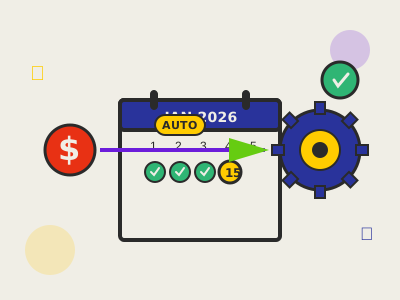
Missing a loan payment can feel like a minor slip-up, but the consequences—from late fees to damaged credit—add up fast. Automating your loan payments is one of the smartest financial moves you can make. Here's why automatic payments are a game-changer and how to set them up correctly.
Why Automate Your Loan Payments?
✅ Benefits
- Never miss a payment: Eliminates human error and forgetfulness
- Protect your credit score: Payment history = 35% of your FICO score
- Save money: Avoid late fees ($25-$40 per missed payment)
- Get interest rate discounts: Many lenders offer 0.25%-0.50% APR reduction
- Reduce stress: One less thing to remember each month
- Build credit history: Consistent on-time payments boost your score
⚠️ Considerations
- Requires sufficient funds: Overdraft fees if balance is low
- Less payment flexibility: Harder to adjust timing spontaneously
- Can lead to complacency: May forget to monitor loan progress
- Account changes: Bank account closures or card expirations require updates
💰 Real Savings Example
Let's say you have a $25,000 auto loan at 6% APR for 5 years:
- Without autopay: 6% APR = $483/month
- With 0.25% autopay discount: 5.75% APR = $480/month
You save $3/month × 60 months = $180 over the loan term, just for automating!
Plus, you avoid potential late fees ($35 × 1-2 missed payments/year = $35-$70 saved annually).
Types of Loans You Can Automate
🏠 Mortgages
Most lenders offer autopay. Some even allow automated extra principal payments.
🚗 Auto Loans
Common autopay discount: 0.25%-0.50% APR reduction when enrolled.
🎓 Student Loans
Federal loans offer 0.25% interest rate reduction; private lenders often match this.
💳 Personal Loans
Nearly all online lenders support autopay. Check for rate discounts.
💰 Credit Cards
Automate minimum payment or full balance—your choice.
How to Set Up Automatic Payments
Step-by-Step Setup Process
-
Log into your lender's website or app
Find the "Payments" or "Manage Account" section
-
Look for "Autopay" or "Automatic Payments"
Often under "Payment Settings" or "Billing Options"
-
Choose your payment amount
Options typically include:
- Minimum payment (credit cards)
- Full statement balance (credit cards)
- Fixed monthly amount (loans)
- Custom amount (extra principal payments)
-
Select your bank account
Provide routing and account numbers, or link via Plaid/instant verification
-
Choose your payment date
Align with your paycheck schedule if possible (e.g., 2-3 days after payday)
-
Confirm autopay discount eligibility
Ask about interest rate reductions when enrolling
-
Review and confirm
Double-check all details before finalizing
-
Set up payment reminders
Get email/text notifications 3-5 days before autopay processes
Best Practices for Autopay Success
1️⃣ Maintain a Buffer in Your Account
Keep at least one month's worth of loan payments as a cushion in your checking account. This prevents overdraft fees if you miscalculate your balance.
2️⃣ Align Payments with Payday
Schedule autopay 2-3 days after you receive your paycheck to ensure funds are available. Most lenders allow you to choose your payment date.
3️⃣ Use a Dedicated Checking Account
Consider opening a separate "bills only" checking account. Deposit enough to cover all automatic payments each month. This prevents accidental overspending.
4️⃣ Enable Low Balance Alerts
Set your bank to notify you when your balance drops below $500 (or whatever threshold covers your autopay amounts + buffer).
5️⃣ Review Statements Monthly
Don't set and forget. Check that payments processed correctly and watch for errors, rate changes, or unexpected fees.
6️⃣ Update Payment Info Immediately
If you close a bank account, change banks, or get a new debit card, update your autopay info ASAP to avoid missed payments.
Strategic Autopay Options
For Credit Cards:
- Pay full statement balance (recommended): Avoid interest entirely, maintain 0% utilization after payment posts
- Pay minimum only: Protects credit score but costs you interest—only use temporarily if cash-strapped
- Pay fixed amount: Good for debt payoff—set amount higher than minimum to accelerate repayment
For Loans:
- Required payment only: Standard option, keeps you on schedule
- Required payment + extra principal: Pay off loan faster, save on interest. Example: $500/month required, autopay $600 with $100 to principal
- Bi-weekly payments: Pay half your monthly amount every two weeks = 13 months of payments per year instead of 12, shaving years off the loan
🚀 Accelerated Payoff Strategy
Automate an extra $50-$100/month toward your loan principal:
Example: $20,000 car loan at 5% APR for 5 years
- Standard payment: $377/month → Total interest: $2,645
- With $100 extra/month: $477/month → Total interest: $1,789
Savings: $856 in interest + loan paid off 16 months early!
Common Autopay Mistakes to Avoid
- ✗ Not monitoring your account: Autopay doesn't mean "ignore it"—check statements monthly
- ✗ Insufficient funds: Overdraft fees ($35) + potential late payment mark on credit report
- ✗ Forgetting to update payment method: Expired cards or closed accounts cause missed payments
- ✗ Autopaying minimum on credit cards: Interest charges pile up—always aim to pay full balance
- ✗ No backup plan: Have overdraft protection or a linked savings account as a safety net
What If Something Goes Wrong?
If Autopay Fails:
- Make a manual payment ASAP to avoid late fees
- Contact your lender and explain—they may waive the fee if it's your first time
- Check your bank account for insufficient funds or technical issues
- Re-enroll in autopay if it was canceled due to the failed payment
- Ask about reinstating autopay discount if it was removed
Your Autopay Checklist
Final Thoughts
Automating your loan payments is one of the easiest ways to improve your financial health. It protects your credit score, saves you money through avoided late fees and interest rate discounts, and eliminates the mental burden of remembering due dates.
The key is to set up autopay responsibly: maintain sufficient funds, monitor your accounts regularly, and use the strategy as a foundation for accelerated debt repayment if your budget allows. With autopay, you're not just paying your bills—you're building a stronger financial future, one automatic payment at a time.